What is it?
Plasterboard is a sheet material used to form internal wall and ceiling linings. It is typically made from a gypsum core sandwiched between layers of paper, forming rigid boards that can be fixed to timber or metal framing.
Boards are cut to size on site and mechanically fixed to studs, joists, or other supporting structures. Joints between boards are taped and filled to create a smooth surface ready for decoration. Plasterboard is widely used because it is quick to install, relatively lightweight, and provides a consistent internal finish.
- 1Slab Soffit
- 2Deflection Head
- 3Plasterboard
- 4Door Frame
What does it do?

Internal finish
Plasterboard provides a smooth, flat surface that can be painted, tiled, or otherwise finished.

Acoustic and fire performance
Gypsum contains chemically bound water, which helps resist the spread of fire. The type and thickness of plasterboard contribute to the fire rating of walls and ceilings. When used in multiple layers or in combination with insulation, plasterboard can help reduce sound transmission between spaces.

Protection
It forms a protective layer over structural elements such as metal studs or timber framing.
Where is it used?
Internal walls: including metal stud and timber stud partitions
Ceilings: fixed to joists or suspended ceiling systems
The inner lining of external walls
Service enclosures and risers
Fire-rated wall and ceiling systems
Types
Plasterboard comes in several variants, each designed to meet different performance needs. Although manufacturers often market boards as being tailored for specific functions, enhancing one performance characteristic frequently leads to gains in other aspects of the wall’s overall performance as well. Manufacturers may colour-code their boards according to their advertised function.
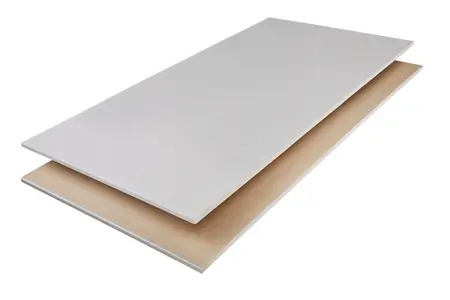
Standard plasterboard
Used for general internal applications where no specific performance is required.
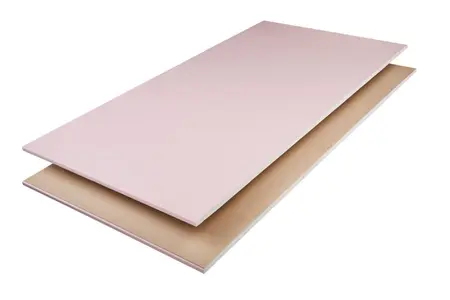
Fire-resistant plasterboard
Contains additives such as glass fibres to improve fire performance and is used in fire-rated constructions.
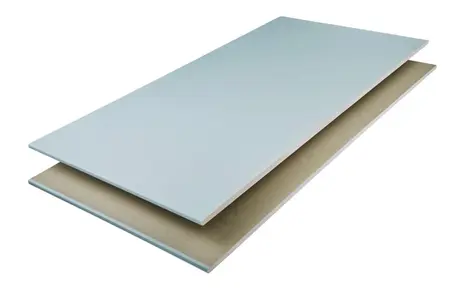
Moisture-resistant plasterboard
Designed for use in areas with higher humidity, such as bathrooms and kitchens.
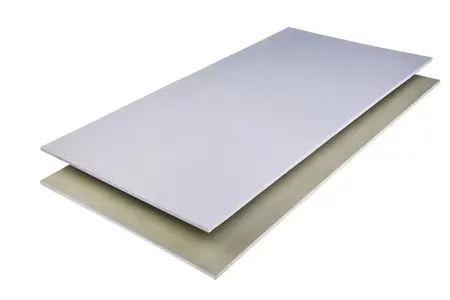
Acoustic plasterboard
Typically higher density, used to improve sound insulation in partitions.
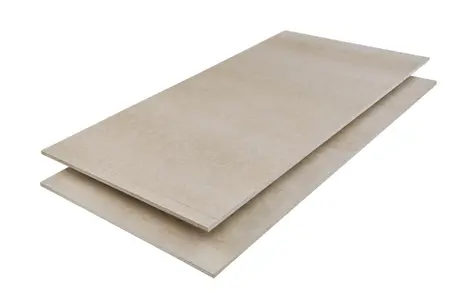
Impact-resistant plasterboard
Stronger boards used in areas subject to higher levels of wear, such as corridors or public buildings.
Typical sizes
Plasterboard is manufactured in standard sheet sizes.
| Dimension | Typical Size |
|---|---|
| Width | 1200 mm |
| Length | 2400 mm / 2700 mm / 3000 mm |
| Thickness | 9.5 mm / 12.5 mm / 15 mm |
Thicker boards or multiple layers are often used to achieve higher fire or acoustic performance.
How to specify
Define performance requirements
Plasterboard is typically specified as part of a complete wall or ceiling system rather than as an isolated product. The required fire resistance, acoustic performance, and durability of the wall or ceiling must first be established.Select a tested system
A suitable build-up is then selected from a manufacturer’s tested systems. These define:- Type and thickness of plasterboard
- Number of layers
- Fixing methods
- Joint treatment
This ensures the required performance is achieved in practice.
Consider finish requirements
The level of finish required (e.g. painted surface, tiled finish) will influence board type and jointing method.
Other considerations
Plasterboard can be finished in different ways depending on the desired appearance and programme. It may be taped and jointed, where joints are filled and sanded. This method is generally faster and more cost-effective, but can result in a slightly less uniform finish, particularly under certain lighting conditions. Alternatively, plasterboard can be skimmed with a thin layer of plaster. This provides a more consistent and uniform surface, but is typically slower to apply and more expensive.
Plasterboard should not be exposed to prolonged moisture, as this can lead to deterioration of the board and the growth of mould. For this reason, it is important that plasterboard is protected during construction and installed in dry conditions.
Once installed, plasterboard should be properly finished and sealed (for example with paint or tile finishes) to prevent moisture from entering the board during use.
Interacting elements
Plasterboard forms part of a wider wall or ceiling system and works in combination with several other elements.
- Metal studs or timber framing: Provide the structural support to which plasterboard is fixed
- Insulation: Installed behind the plasterboard to improve acoustic and sometimes thermal performance
- Fixings: Screws or nails secure the boards to the supporting structure
- Jointing materials: Tape and jointing compound are used to create a continuous finished surface
- Finishes: Paint, tiles, or other finishes are applied to the plasterboard surface
- Services: Electrical boxes and other fittings are integrated within the plasterboard lining
Popular manufacturers

British Gypsum
The UK's leading manufacturer of plasterboard and drylining systems, widely specified across residential and commercial projects.

Knauf
Global manufacturer of drylining, insulation and ceiling systems. Strong presence in UK commercial construction.

Siniat
Specialist in plasterboard and partition systems, often positioned as a value alternative to the larger brands.