Tanking
Tanking is the waterproof layer behind a bathroom's tiles, a membrane or coating over the walls and floor that stops water reaching the board and frame.
- Fitted by
- Tiler
- Sheet membrane thickness
- a fraction of a millimetre
- Overlap at sheet joints
- at least 50 mm
- Joint and corner tape
- about 100 to 125 mm wide
- In the models
- Bathroom
What it is
Tanking is the waterproofing behind the tiles in a bathroom or wet room. Tile and grout are not waterproof on their own: water gets through fine cracks in the grout and soaks the board behind, and over time that can rot timber, soften plasterboard and leak into the rooms below. Tanking puts a continuous waterproof layer under the tiles so that water can only reach the surface.
It can be a sheet membrane bonded on in tile adhesive, as in this bathroom, a liquid coating brushed or rolled on, or waterproof boards with sealed joints. Whatever the system, the weak points are the joints: the internal and external corners, the junction of wall and floor, the edge of the bath and every pipe or fixing through it. Each system has its own tapes, corners and collars to seal these.
What it does
- Keeping water out of the walls and floorThe membrane stops water that gets through the grout from reaching the board, the studs and the floor, protecting the structure and the room below.
- Sealing the jointsTapes over the sheet joints and the wall to floor junctions, preformed corners and collars round pipes keep the layer continuous where it is most likely to fail.
- Sealing to the bathA sealing band bonded to the bath's edge and lapped under the wall membrane closes the gap where the bath meets the wall.
Where you’ll find it
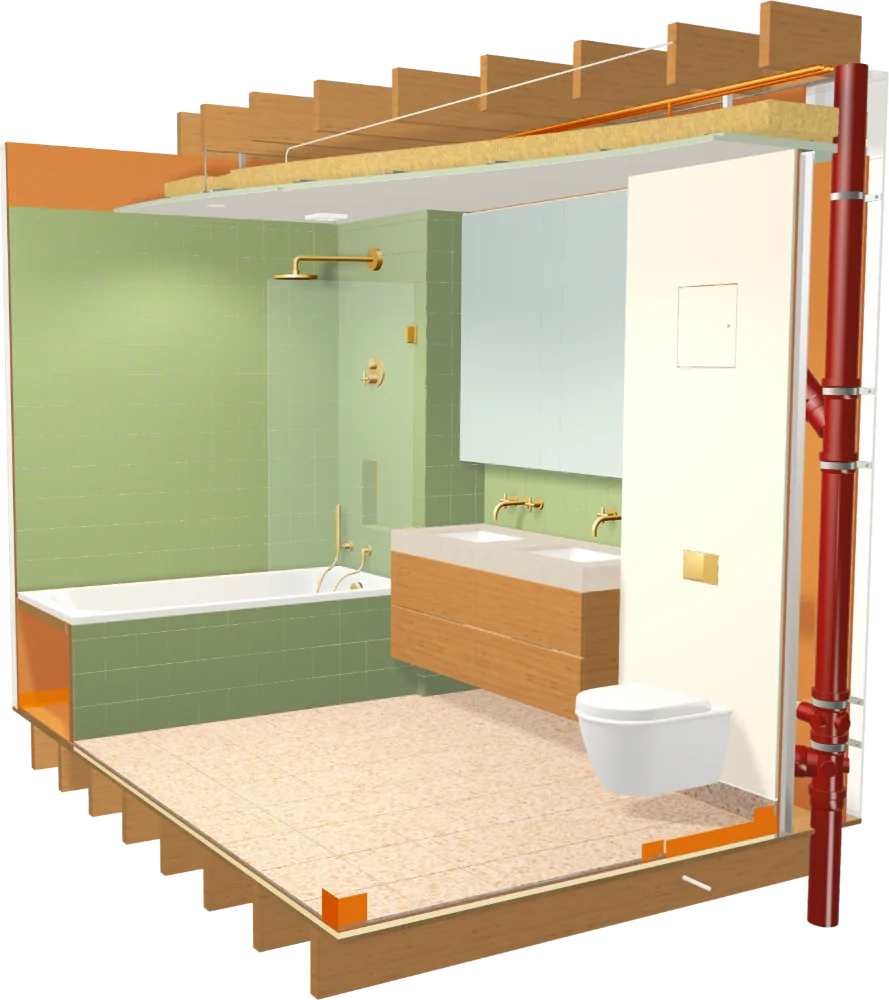
- Around baths and showersOn every wall the shower can wet, full height, and down behind and below the bath.
- Wet room floorsAcross the whole floor and up the walls, laid to the fall of the floor and sealed into the floor drain.
- Across the bathroom floorOver the whole floor and turned up the walls, as here, so a leak or an overflowing bath is held.
Types
Tanking systems are grouped by what forms the waterproof layer.
Sheet membrane
A thin waterproof sheet bonded on in tile adhesive, with its joints lapped and sealed. Even thickness everywhere, and tiling can follow straight on. Schlüter KERDI, as here, is one.
Sizes
Tanking is thin, but the laps and seals at its joints matter more than its thickness.
- Sheet membrane thicknessa fraction of a millimetre
- Overlap at sheet jointsat least 50 mm
- Joint and corner tapeabout 100 to 125 mm wide
- Height round a bath or showerfull height where the shower can reach
- Floor upstandturned up the walls at the edges
How to specify
Choose one tanking system and use its own tapes, corners, collars and adhesive throughout, since mixing products is a common cause of leaks.
- 1System and extentPick a sheet, liquid or board system and mark where it goes: every wall the shower can wet, behind the bath, and the floor.
- 2Joints and penetrationsList every corner, junction, pipe and fixing, and specify the system's tape, corner piece or collar for each. Seal the bath edge with the system's band before the wall membrane goes on.
- 3Substrate and tilingCheck the board behind suits the system, use the adhesive the maker names, and let any liquid coating cure fully before tiling.
Things to watch
Code of practice. BS 5385, the code of practice for tiling, covers wet areas, including the substrate and the waterproofing behind tiles that will be wetted.
Substrate. Gypsum plaster and ordinary plasterboard soften if they get wet. Tank over a moisture resistant board or tile backer board, not plain plaster.
Penetrations. Every pipe, valve and screw through the membrane is a leak waiting to happen unless it has its own collar or sealant.
Bath edge. Silicone alone will fail at the bath edge. Bond a sealing band to the bath and lap the membrane over it.
Testing. In a wet room it is worth flood testing the tanked floor before tiling, as leaks are far easier to fix then.
One system. Use one maker's tanking products together. Their warranties usually depend on it.
Works with
Tanking works with the elements around it.
- Tile backer boardis the substrate it is bonded to.
- Tilingis bedded straight on top of it.
- Bathis sealed to it along its rim.
- Showerand hot and cold supplies pass through it, each with its own collar.
Popular manufacturers
- Visit website
Schlüter-Systems
A German maker of tiling systems, including the KERDI membrane, KEBA tapes, KERECK corners and KERDI-MV collars used in this model.
- Visit website
ARDEX
A German maker of tile adhesives, grouts and waterproofing, with liquid and sheet tanking systems for bathrooms and wet rooms.
- Visit website
wedi
A German maker of waterproof foam building boards and wet room systems, with its own tapes and sealants to close the joints.