Tile Backer Board
Tile backer board is a water resistant cement or foam board fixed to studs or a floor to tile onto, in place of plasterboard in wet areas.
- Fitted by
- Tiler
- Sheet size
- commonly 1200 x 600 or 1200 x 800 mm
- Wall boards
- about 10 to 12.5 mm on studs
- Floor boards
- about 6 to 12 mm over a deck
- In the models
- Bathroom
What it is
Tile backer board is a sheet board made to be tiled onto in bathrooms, wet rooms and kitchens. It is fixed to the studs of a wall or over a timber floor in place of plasterboard or plywood, and gives a flat, stable, water resistant surface for the tanking and the tiles.
Ordinary plasterboard has a gypsum core and paper faces that soften and lose strength if they get wet, which makes it a poor base for tiles where water is used. Backer boards are made of cement, often reinforced with fibre or mesh, or of a rigid foam core coated in a cement layer, so they are not harmed by water. Foam boards are light and insulate, while cement boards are heavier and very hard wearing.
What it does
- A stable base for tilesThe board gives the tiles a flat, rigid surface that will not soften or move if it gets damp, so the tiles and grout stay bonded.
- Standing up to waterUnlike plasterboard, a backer board is not damaged by water. With tanking over it, the wall or floor is protected even if water gets through the grout.
- Stiffening a timber floorScrewed and bonded over a plywood deck, it adds stiffness and gives a better base for floor tiles than timber alone.
Where you’ll find it
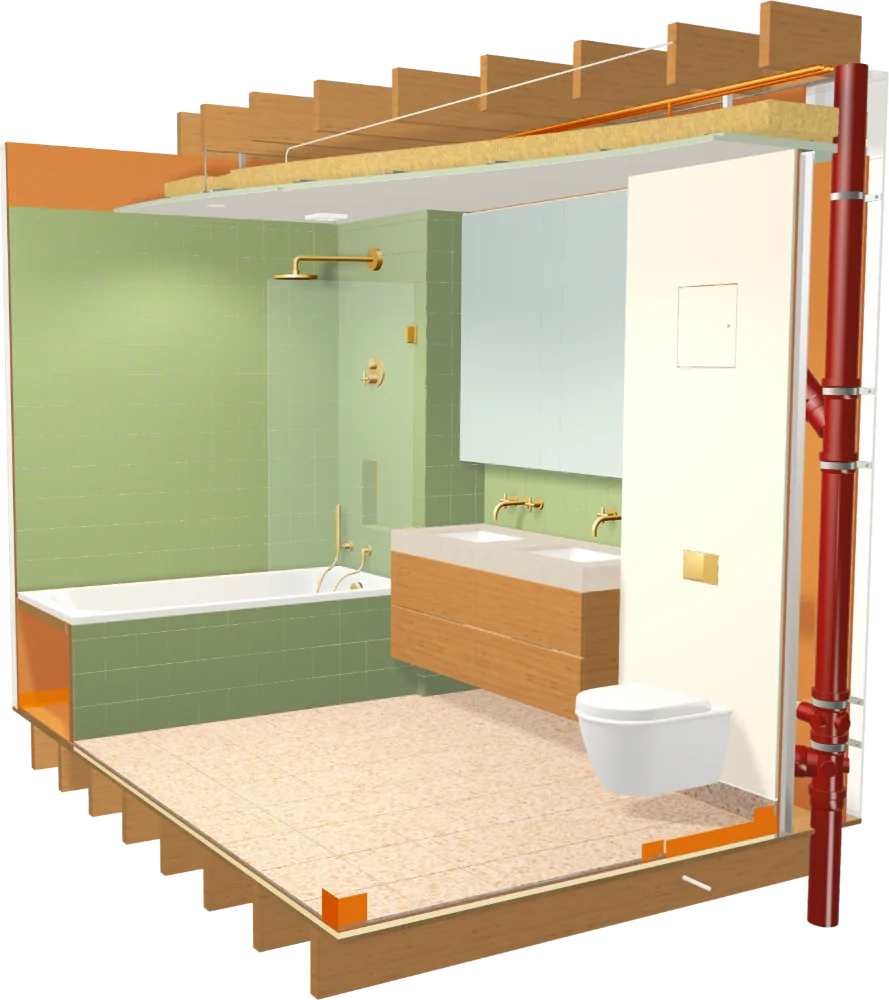
- Bath and shower wallsOn every wall that will be tiled and wetted, fixed straight to metal or timber studs, or over plywood sheathing as here.
- Bathroom floorsOver a timber deck, under the tanking and tiles, and over underfloor heating panels.
- SplashbacksBehind tiles over a basin or kitchen worktop.
Types
Backer boards are grouped by what they are made of, which sets their weight, strength and how they are cut and fixed.
Cement board
Cement reinforced with fibres or glass mesh. Strong, hard wearing and fire resistant, but heavy and dusty to cut.
Sizes
Board thickness depends on whether it is on a wall or a floor and how far apart the supports are.
- Sheet sizecommonly 1200 x 600 or 1200 x 800 mm
- Wall boardsabout 10 to 12.5 mm on studs
- Floor boardsabout 6 to 12 mm over a deck
- Fixingscrews with washers, at close centres
- Jointstaped or sealed to the maker's system
How to specify
Choose the backer board with the tanking and the tiles, since the board has to suit both and the stud spacing behind it.
- 1Board typePick cement or foam board to suit the wall or floor, the weight of the tiles and whether you want it to insulate.
- 2Thickness and fixingChoose a thickness to suit the stud or joist spacing and the load, and fix with the maker's screws and washers at the centres they give. On a floor, bond and screw it to the deck.
- 3Joints and tankingTape or seal the joints as the maker requires, and check that the tanking and tile adhesive are approved for that board.
Things to watch
Not plasterboard. Ordinary plasterboard is not suited to areas that will be wetted. Use backer board or a board the maker approves for tiling in wet areas.
Stud spacing. Wide stud spacing needs a thicker or stiffer board. Check the maker's limits.
Heavy tiles. Large porcelain or stone tiles are heavy. Check the board and its fixings can carry them.
Floors. A floor board only stiffens a deck that is already sound. The joists and plywood beneath must be stiff enough first.
Cutting dust. Cutting cement board makes fine dust containing silica. Cut outside or with extraction.
Works with
Tile backer board works with the elements around it.
- Metal studsor a plywood deck carry it.
- Tankingis bonded over it.
- Tilingis bedded on top.
- Underfloor heatingpanels can sit beneath it on a floor.
Popular manufacturers
- Visit website
wedi
A German maker of waterproof foam building boards for walls and floors, with mesh reinforced cement coatings and its own sealing system.
- Visit website
Marmox
A maker of insulated tile backer boards for walls and floors in bathrooms and wet rooms, with a lightweight foam core and a reinforced cement-based facing.
- Visit website
No More Ply
A UK supplier of fibre cement boards from 4.5 to 22 mm thick, for tile backing on walls and floors, along with foam boards for wet areas.