Soil and Waste Pipes
Soil and waste pipes carry used water away: waste pipes from basins and baths, the WC's soil pipe, and the soil stack they all run into.
- Fitted by
- Plumber
- Basin waste
- 32 mm, or 40 mm for longer runs
- Bath and shower waste
- 40 mm
- WC and soil stack
- about 100 to 110 mm
- In the models
- Bathroom
What it is
Soil and waste pipes take used water out of the bathroom and down to the drains. Waste pipes carry water from basins, baths and showers. The soil pipe carries the WC's flush. They join the soil stack, the large vertical pipe that runs down through the building to the underground drain, and is vented at the top so air can move in and out as water flows.
Every basin, bath and shower has a trap under its waste, a bend that holds a little water to stop drain smells coming into the room. The branch pipes from each fitting run to the stack at a steady fall. Most are plastic, solvent welded or with push fit ring seals, with access points so blockages can be cleared.
What it does
- Carrying water awayThe pipes carry used water from every fitting to the stack and the drains, at a fall that keeps it moving.
- Keeping smells outEach trap holds a water seal against the drains, and the vented stack stops that seal being sucked or pushed out as water runs.
- Letting blockages be clearedAccess fittings and rodding eyes let a blockage be cleared without taking the pipework apart.
Where you’ll find it
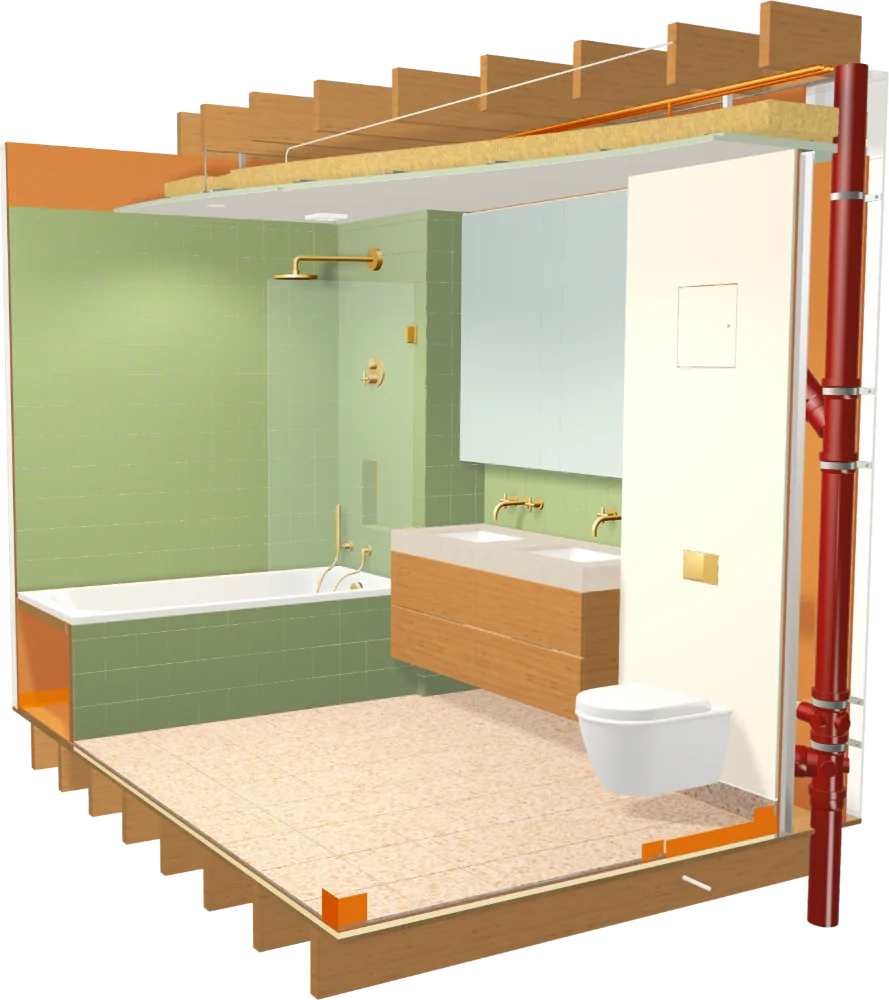
- In service risers and boxingsHidden in boxed out risers beside the WC and bath, as here, with access panels.
- Under baths and vanity unitsRunning from the traps to the stack behind the bath panel and inside the vanity unit.
- Through floorsDropping to the floor below or running in the floor void, where the joists allow.
Types
Soil and waste pipes are grouped by what they carry and how they are joined.
Soil pipe and stack
Large pipe, usually 110 mm in plastic, carrying WC waste and forming the main stack. Joined with push fit ring seal sockets.
Sizes
Pipe sizes and branch lengths are set out in Approved Document H.
- Basin waste32 mm, or 40 mm for longer runs
- Bath and shower waste40 mm
- WC and soil stackabout 100 to 110 mm
- Longest simple branchbasin 1.7 m, bath 3 m, WC 6 m
- Falla steady fall along each run
How to specify
Plan the soil and waste routes as soon as the fittings are placed, since the stack position and falls fix where the WC, bath and basins can go.
- 1Stack and routesFind the stack and plan a route from each fitting to it, keeping branches short with a steady fall and few bends.
- 2Sizes and trapsSize each pipe and trap for its fitting, using a larger pipe or venting where a run is long or several fittings share a pipe.
- 3AccessPlace access fittings and a rodding eye where blockages are likely, with access panels in the boxing so they can be reached.
Things to watch
Approved Document H. Approved Document H, section H1, sets trap sizes and seal depths, branch sizes and lengths, and how stacks are vented.
Falls. Too flat and water will not carry waste; too steep and it can pull the trap's seal. Keep a steady fall.
Venting. The stack is vented to the open air, or fitted with an air admittance valve where the regulations allow.
Access. Leave a way to rod every run, and do not tile over access fittings.
Noise. Plastic stacks can be noisy as water falls. Wrap or box them with acoustic insulation in quiet rooms.
Fire. Where a pipe passes through a fire separating floor or wall, the hole must be fire stopped, often with a collar.
Works with
Soil and waste pipes work with the elements around them.
- WCdischarges into the soil pipe.
- Bathand basin drain through their traps into the waste pipes.
- Metal studsand plasterboard form the risers that hide the stack.
- Tankingis sealed round the bath waste where it passes through the riser.
Popular manufacturers
- Visit website
Wavin
A plastic pipe maker whose UK ranges include OsmaSoil soil systems and OsmaWeld solvent weld waste, used in this model.
- Visit website
Polypipe
A UK maker of soil, waste and drainage pipe systems in plastic, with push fit and solvent weld ranges.
- Visit website
FloPlast
A UK maker of plastic soil, waste and rainwater systems for homes.